DeepSeek V4 Freezes Out Nvidia and AMD: What the Huawei Head Start Signals for the AI Chip Race | X01
DeepSeek
analysis February 27, 2026
DeepSeek V4 Freezes Out Nvidia and AMD: What the Huawei Head Start Signals for the AI Chip Race
DeepSeek’s decision to grant Huawei and domestic Chinese chipmakers exclusive early access to its upcoming V4 model, while blocking Nvidia and AMD entirely, marks a strategic inflection point in the global battle for AI hardware supremacy.
DeepSeek’s latest move is being read in the press as a chip access story. It is actually a strategy story, one with long-range consequences for the entire AI hardware ecosystem and for who gets to define the optimization standards that every future model will be built against.
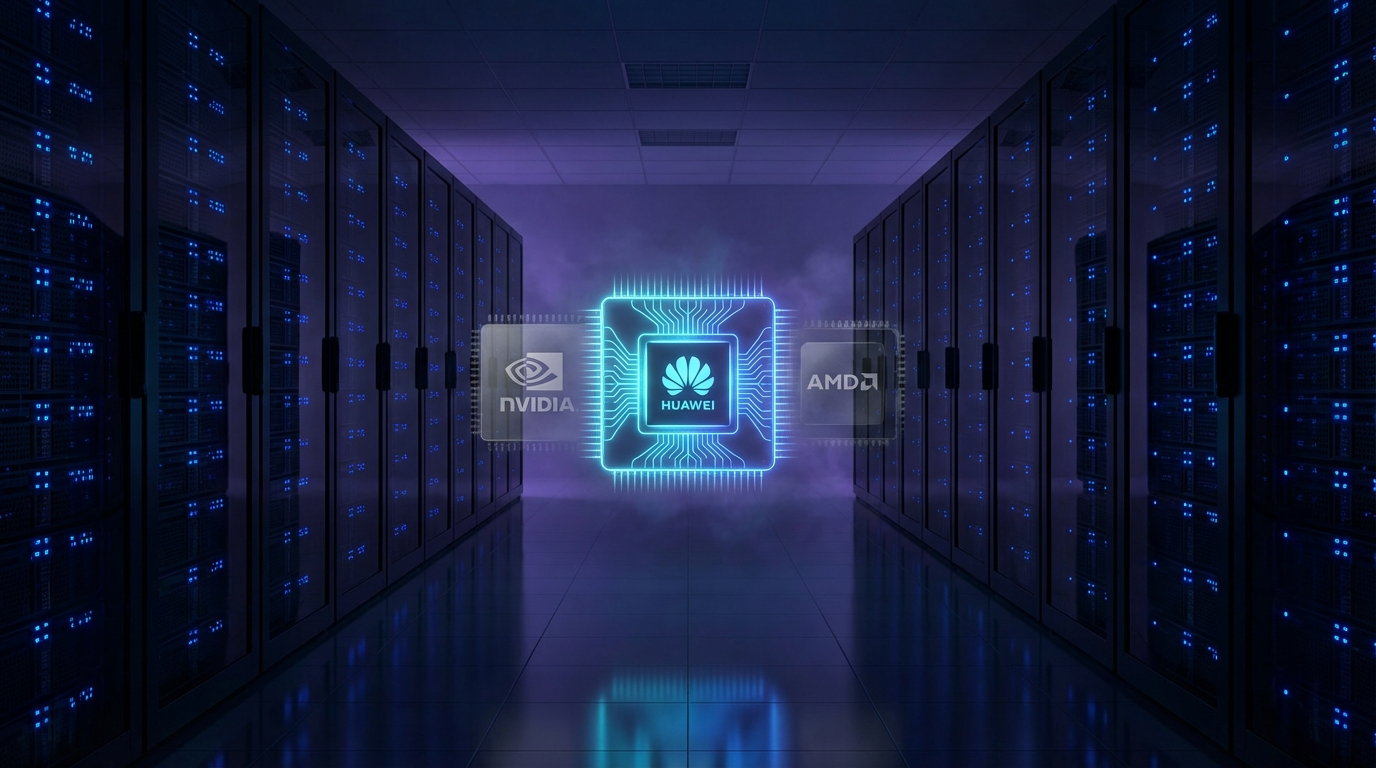
According to sources cited by Reuters, the Chinese AI lab has deliberately withheld pre-release access to its forthcoming flagship model, V4, from both Nvidia and AMD. The same access, traditionally extended to all major chipmakers as standard industry practice, was granted exclusively to Huawei and other domestic Chinese semiconductor vendors. The head start is measured in weeks, enough time for Huawei’s engineering teams to tune their compiler stacks, inference runtimes, and hardware drivers for the new model architecture before their American counterparts even receive the weights.
The Early Access Convention and Why It Mattered
To understand the significance of what DeepSeek has done, it helps to understand what the old convention was and what function it served.
When a major AI lab prepares to release a frontier model, it routinely shares pre-release copies with chipmakers like Nvidia and AMD. The chipmakers’ software teams analyze the model’s computational graph, identify optimization opportunities, and update their CUDA kernels, ROCm libraries, and inference frameworks accordingly. By launch day, performance on the dominant hardware stacks is polished. Early adopters get a smooth experience. The model gains mindshare. Everyone benefits, or so the logic goes.
This arrangement also had a subtler function: it locked in optimization primacy for whoever held the pre-release copy. Nvidia’s TensorRT inference library, for example, routinely ships model-specific optimizations that deliver throughput gains of twenty to forty percent over naive implementations. Those gains arrive at launch, not months later. A chipmaker that receives early access gets to ship day-one benchmarks that establish the performance baseline in users’ minds.
DeepSeek has now severed that loop for US silicon, deliberately and by all indications permanently.
What Huawei Gains
The practical effect is significant. Huawei’s Ascend AI accelerators have long lagged Nvidia’s H100 and Blackwell GPUs on raw inference throughput when running Western frontier models. The gap is partly architectural and partly a software problem: Huawei’s toolchain has simply had less time to optimize against the models that matter most in the market.
A multi-week exclusive optimization window against DeepSeek V4 changes that calculus. By the time V4 launches publicly, Huawei will have inference software purpose-built for the model’s architecture. Early benchmarks run on Huawei hardware will reflect weeks of targeted tuning. The narrative that Ascend accelerators cannot compete with Nvidia for serious AI workloads, a narrative that has hindered Huawei’s ability to sell into the Chinese enterprise market where DeepSeek’s models are increasingly the reference standard, will have a concrete data point against it.
The compounding effect matters too. If DeepSeek continues this practice with V5, V6, and future generations, Huawei’s optimization advantage accumulates over successive model cycles. The gap does not just close. It reverses.
The Compliance Shadow
There is a second dimension to this story that carries its own risks. A senior Trump administration official told Reuters that DeepSeek’s V4 model was reportedly trained, at least in part, on Nvidia Blackwell chips running in a mainland China cluster. If accurate, this represents a potential violation of US export controls that prohibit the shipment of advanced AI accelerators to China without a license.
More striking is the allegation that DeepSeek may be planning to obscure this lineage. According to the same source, there are indications the lab intends to remove technical markers that would identify the training hardware as American silicon and replace them with indicators pointing to Huawei chips. If accurate, this would represent not just a compliance concern but a deliberate effort to launder the provenance of a model’s training compute, using American hardware to achieve capability thresholds, then attributing the achievement to domestic silicon for both regulatory and competitive purposes.
Neither DeepSeek nor Huawei responded to requests for comment. The veracity of the training hardware claims has not been independently confirmed. But the allegation, even unverified, shapes how US regulators and chipmakers will read the early-access decision.
The Benchmark Model vs. the Production Model
Ben Bajarin of Creative Strategies offered a framing worth examining. He argued that Nvidia and AMD’s exposure is limited because DeepSeek functions primarily as a benchmarking model rather than a production workload in most enterprise environments. Most enterprises are not running DeepSeek at scale, he noted; they are running it against competitors to calibrate expectations.
That framing was accurate twelve months ago. It is less accurate today. DeepSeek’s models, beginning with the R1 release in early 2025, have crossed from benchmark curiosity to genuine production deployment in Chinese enterprise software stacks. The combination of strong reasoning performance and radically lower inference cost has made DeepSeek the default reference model for much of the Chinese AI market. As V4 arrives, that installed base will determine real-world hardware purchase decisions, not hypothetical benchmark comparisons.
Bajarin’s secondary point is more durable: new AI coding techniques are compressing the time required to port software optimizations from months to weeks. If that compression continues, the lead time advantage Huawei receives from early access shrinks as a share of the total optimization window. But it does not disappear, and first-mover benchmark claims retain a stickiness in market perception that technical parity achieved later rarely fully erodes.
The Strategic Read
The most useful lens for this development is not chipmaker competition but ecosystem design. DeepSeek is not simply choosing a hardware partner; it is making a statement about which optimization standard will govern the model’s deployment lifecycle. By anchoring V4’s software stack around Huawei’s toolchain rather than Nvidia’s, DeepSeek ensures that the model performs best, at launch, on hardware that Chinese enterprises are permitted to buy without navigating US export restrictions.
See also: The AI Interface Wars: Chat vs. Voice vs. Agents | X01.
For related context, see The AI Model Wars: February 2026 Rankings | X01.
A multi-week exclusive optimization window against DeepSeek V4 changes that calculus. By the time V4 launches publicly, Huawei will have inference software purpose-built for the model’s architecture. Early benchmarks run on Huawei hardware will reflect weeks of targeted tuning. The narrative that Ascend accelerators cannot compete with Nvidia for serious AI workloads, a narrative that has hindered Huawei’s ability to sell into the Chinese enterprise market where DeepSeek’s models are increasingly the reference standard, will have a concrete data point against it.
The compounding effect matters too. If DeepSeek continues this practice with V5, V6, and future generations, Huawei’s optimization advantage accumulates over successive model cycles. The gap does not just close. It reverses.
The Compliance Shadow
There is a second dimension to this story that carries its own risks. A senior Trump administration official told Reuters that DeepSeek’s V4 model was reportedly trained, at least in part, on Nvidia Blackwell chips running in a mainland China cluster. If accurate, this represents a potential violation of US export controls that prohibit the shipment of advanced AI accelerators to China without a license.
More striking is the allegation that DeepSeek may be planning to obscure this lineage. According to the same source, there are indications the lab intends to remove technical markers that would identify the training hardware as American silicon and replace them with indicators pointing to Huawei chips. If accurate, this would represent not just a compliance concern but a deliberate effort to launder the provenance of a model’s training compute, using American hardware to achieve capability thresholds, then attributing the achievement to domestic silicon for both regulatory and competitive purposes.
Neither DeepSeek nor Huawei responded to requests for comment. The veracity of the training hardware claims has not been independently confirmed. But the allegation, even unverified, shapes how US regulators and chipmakers will read the early-access decision.
The Benchmark Model vs. the Production Model
Ben Bajarin of Creative Strategies offered a framing worth examining. He argued that Nvidia and AMD’s exposure is limited because DeepSeek functions primarily as a benchmarking model rather than a production workload in most enterprise environments. Most enterprises are not running DeepSeek at scale, he noted; they are running it against competitors to calibrate expectations.
That framing was accurate twelve months ago. It is less accurate today. DeepSeek’s models, beginning with the R1 release in early 2025, have crossed from benchmark curiosity to genuine production deployment in Chinese enterprise software stacks. The combination of strong reasoning performance and radically lower inference cost has made DeepSeek the default reference model for much of the Chinese AI market. As V4 arrives, that installed base will determine real-world hardware purchase decisions, not hypothetical benchmark comparisons.
Bajarin’s secondary point is more durable: new AI coding techniques are compressing the time required to port software optimizations from months to weeks. If that compression continues, the lead time advantage Huawei receives from early access shrinks as a share of the total optimization window. But it does not disappear, and first-mover benchmark claims retain a stickiness in market perception that technical parity achieved later rarely fully erodes.
The Strategic Read
The most useful lens for this development is not chipmaker competition but ecosystem design. DeepSeek is not simply choosing a hardware partner; it is making a statement about which optimization standard will govern the model’s deployment lifecycle. By anchoring V4’s software stack around Huawei’s toolchain rather than Nvidia’s, DeepSeek ensures that the model performs best, at launch, on hardware that Chinese enterprises are permitted to buy without navigating US export restrictions.
That is a coherent strategy for a Chinese AI lab operating in a world where the supply chain for advanced compute is contested. Whether it reflects Chinese government direction, commercial pragmatism, or some combination of both, the effect is the same. The optimization moat that Nvidia has built around frontier model deployment, the moat that makes switching to alternative hardware painful even when the hardware itself is competitive, is being deliberately undermined for the models that define the Chinese AI market.
Nvidia and AMD will eventually receive the V4 weights through public release and run their own optimization passes. But they will be catching up to an already-established baseline rather than setting it. In the AI hardware business, where developers benchmark first and commit infrastructure budgets second, that sequence matters more than the eventual performance delta.
DeepSeek’s early access decision is, at its core, a declaration about who gets to define what good looks like for the next generation of AI inference. The answer, at least for DeepSeek’s model family, is no longer Nvidia.